
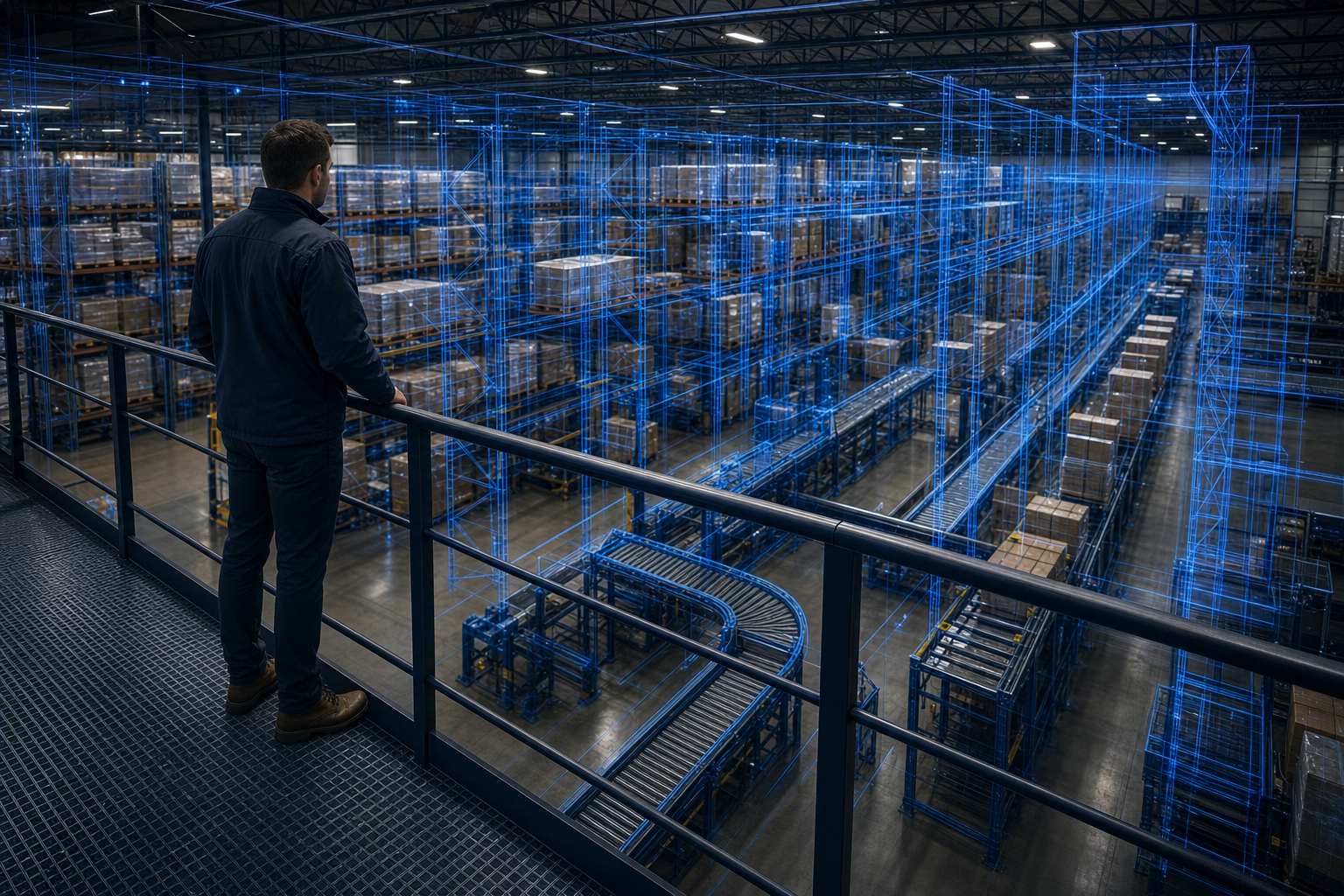
One of the most useful moments in a digital-twin effort is also one of the least comfortable.
An operator watches the model run and says, “That is not how the day works.”
It can sound like resistance. It may be the first meaningful validation result.
A digital twin can reproduce equipment, travel paths, process steps, labor rules, and transaction logic with impressive precision. None of that answers the question in the title: which reality is the twin intended to represent?
There is the operation described by the standard process. There is the operation being run today, with its exceptions and local controls. There is also the future operation leadership wants to create. A model may include elements of all three, but it should not blend them silently.
That is how a plausible-looking twin becomes difficult to trust.
Suppose the standard says work moves immediately after completion. The current operation holds some of it because the downstream area fills at a predictable time. The future design adds capacity and changes the release rule. If the model uses the future capacity, today’s release logic, and the standard handoff time, it represents no operating state the business has ever run or explicitly designed.
The output may still look reasonable. That is the problem.
Realism is not fidelity
Visual realism is a weak test of fidelity. A recognizable building, animated equipment, and moving units help people orient themselves, but decisions depend on behavioral fidelity. The model must respond to conditions in ways the operation can recognize and explain.
Where does work-in-process accumulate? Which constraint appears first as volume changes? How does the priority rule alter the queue? What happens after an outage? How long does recovery take, and which intervention makes it possible? Those behaviors matter more than whether the virtual asset resembles the physical one.
Name the reality you are modeling
I would make the intended reality explicit in the model design.
For a current-state twin, the goal is an honest baseline. It should include consequential workarounds, ordinary variability, actual decision rules, and known reliability limits. That does not endorse every current practice. It creates a credible point of comparison.
For a future-state twin, the proposed changes should be separately identified. New equipment, revised staffing, altered release rules, and different process boundaries are assumptions to test. Keeping them distinct allows a leader to see which change produced the result instead of receiving a polished combination that cannot be unpacked.
For a transition model, the intermediate states deserve attention. A future design may be sound after all equipment is installed and every team is trained. The business still has to operate while capability arrives in stages. A twin that jumps directly from current to complete can miss the period carrying the greatest execution risk.
Versioning helps. The baseline, proposed design, and transition scenarios should share definitions where appropriate while preserving their differences. When an assumption changes, the team should know which results are affected. When an operating rule is simplified, the reason and decision impact should be visible.
That discipline prevents an especially subtle problem: improvement leaking into the baseline. A cleaner future rule can be so appealing that it is quietly used to calibrate the current state. The comparison then overstates today’s performance and understates the work required to reach the proposed design. Keeping the states separate protects both the diagnosis and the business case.
Validate behavior, not totals
Then validation can move beyond general agreement.
Start with signature behaviors rather than only total output. Identify a normal period operators recognize, a difficult period with explainable causes, and a recovery period. Compare queue location, timing, resource use, constraint movement, completion pattern, and service outcome. A model that reaches the correct total for the wrong operational reason is not yet decision-grade.
Operators are essential here because they know the sequence of the day. System owners know what the records mean and where definitions changed. Modelers know what has been abstracted. Leaders know which discrepancy would alter the decision. Validation works when those perspectives meet around specific behavior rather than around whether someone “believes in” the model.
Disagreement should be recorded, not smoothed away in the meeting.
If the model says a queue should form at 2:00 and the floor says it forms before noon, trace the cause. Perhaps the arrival profile is too even. Perhaps available labor was confused with scheduled labor. Perhaps an unreliable asset is modeled at its nominal rate. Perhaps operators are protecting a downstream commitment that the logic does not include.
Each explanation improves more than the model. It exposes something the organization should understand about its operation.
How much detail is enough
There is also a limit to fidelity. A twin does not need every movement, exception, or individual choice. Detail should earn its place by changing a decision, a constraint, or confidence in the outcome. Otherwise, the model becomes harder to maintain without becoming more useful.
That balance is why “How detailed is the twin?” is less useful than “Which behaviors must it preserve?”
The purpose of a digital twin is to test consequences before the live operation absorbs them. It should let leaders alter a condition, watch pressure move, and understand why the result changed. If the twin fails, it should fail for reasons that teach the business something recognizable.
So when someone closest to the work says, “That is not how the day works,” slow down.
Do not defend the rendering. Find the reality the model missed, decide whether that reality belongs in the baseline or the proposed design, and test again.
The value of a twin is not that it looks like the operation.
It is that the operation can recognize itself in the way the twin behaves.